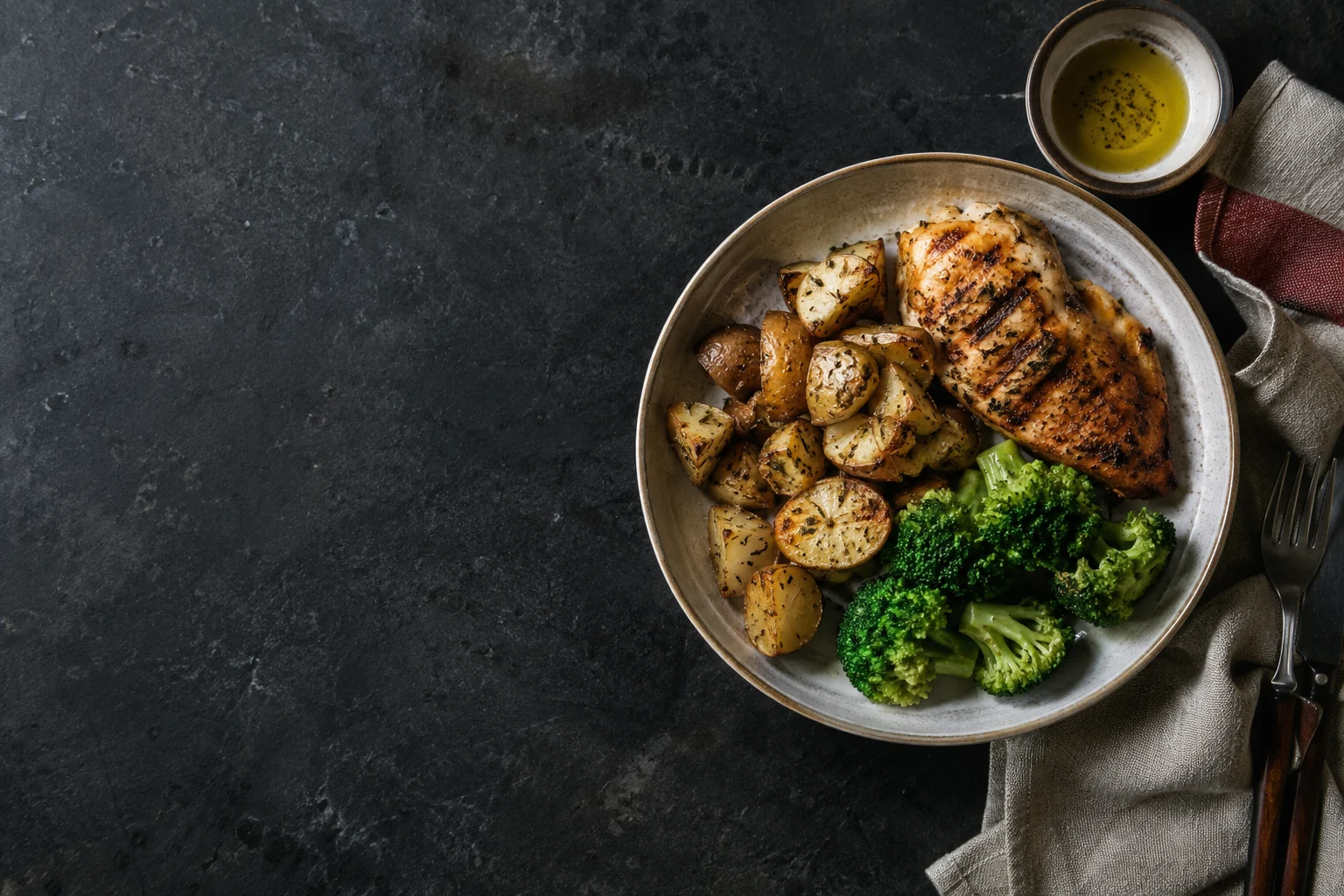
You don't need another diet.
You need to understand what actually matters, then make it work on a normal day. The one with work, kids, dinner, and about twelve other things competing for your attention.
I'm Mike, the dad behind DADSCAPED. This guide is here to help you make sense of nutrition without making food a second job. We'll cover what to eat, how much to eat, how fat loss works, and what to do when the scale stops cooperating. You'll also get the details on supplements, popular diets, alcohol, and the rules you can stop worrying about.
This isn't a menu telling you to eat specific foods at specific times. You have a family. You eat at restaurants. Some days lunch happens in the truck. A useful approach has to survive those situations.
A strict meal plan can remove decisions for a while, but understanding the decisions gives you something you can use anywhere. If dinner changes, you still know how to put a meal together. If you travel, you don't need to declare the week a loss. And if you eat something because you actually enjoy it, you don't need to start over on Monday.
The goal is to lose fat when you need to, support muscle, and build a way of eating you can keep doing. That takes changes and repetition. It doesn't require making every meal perfect.
Read straight through if you want the full picture. Use the contents if there's a particular question on your mind. The calculator in the calorie chapter is there to explain the math, not hand you a magic number.
You already make room for the things your family and your work need. Your own health needs a place in that schedule too.
Make eating well easier.
Fat loss requires an energy deficit over time: your body uses more energy than you take in. That tells us what has to happen. It doesn't tell us how to make it manageable while you're hungry, tired, and standing in front of the pantry.
Food choices and your environment matter because they affect how easy it is to eat an amount that fits your goal. You can overeat nutritious food, and you can include enjoyable processed foods while losing fat. Neither fact makes food quality irrelevant.
What the ultra-processed food study actually found
In a controlled inpatient study, 20 adults ate an ultra-processed diet for two weeks and an unprocessed diet for two weeks, in randomized order. They could eat as much or as little as they wanted. During the ultra-processed period they ate about 508 more calories per day and gained roughly two pounds; during the unprocessed period they lost roughly two pounds. The extra intake came from carbohydrate and fat, not protein. [1]
That's a useful finding about the diets studied. It isn't proof that every packaged food is bad, or that one ingredient explains the entire result. It does suggest that the mix of foods around you can make eating more easier without it feeling like a deliberate decision.
A closer look at the study
Each participant experienced both diets, with the second two-week period immediately following the first. This was a small, short, tightly controlled experiment, not a promise about what any individual will lose at home. Meals were designed to match several presented nutrients. Differences in how the diets were eaten and experienced still mattered. “It was all the sugar” or “it was all the fiber” goes beyond what this experiment establishes.
Read the original research →Set up the room you're eating in
If the easiest thing to grab is a bag of chips, you'll need willpower every time you walk past it. If lunch is ready and you have food you actually like, the decision gets easier. You don't have to ban the kids' snacks from the house. Give yourself options that aren't their leftovers.
Shop with a few meals in mind. Prepare enough protein to cover more than one meal. Keep fruit visible and something useful in the freezer. Grocery pickup, frozen vegetables, canned beans, and microwave rice are perfectly reasonable tools. Convenience can work for you.
Most of your intake should come from foods that help cover protein, fiber, vitamins, and minerals. An 80/20-style approach can be a helpful reminder that there's room for enjoyment. It isn't a scientific boundary where 79% fails and 80% produces perfect health.
Think about the overall amount, too. A day with several nutritious meals and one very large snack is not automatically balanced just because most eating occasions looked good. Oils, drinks, dressings, grazing, and weekend portions all contribute energy.
Fiber deserves more attention
Fiber is a type of carbohydrate that isn't digested like starch or sugar. Different fibers support bowel function, feed gut microbes, or help with cholesterol and blood-glucose management. Fiber-rich foods can also make meals more filling.
A large analysis of cohort studies linked higher fiber intake with lower all-cause mortality. That's an association, not a guarantee that a particular number of grams extends your life by a fixed amount. It's another reason to regularly include plant foods rather than chasing the lowest possible carb count. [2]
A useful general reference is about 14 grams per 1,000 calories, or 28 grams at 2,000 calories. Needs and tolerance vary. If you're eating very little fiber now, increase gradually and drink adequate fluids rather than doubling it overnight. Your digestive system does not enjoy surprise parties. [3]
Psyllium can help fill a fiber gap, but it doesn't provide all the nutrients and variety of those foods. Follow its directions, including fluid instructions, and check interactions with medications. If you have a digestive condition or a prescribed low-fiber diet, use your clinician's guidance instead of this general target.
Carbs aren't uniquely fattening
Rice, potatoes, fruit, and oats can all fit a fat-loss diet. Dietary fat can fit too. Cutting one macronutrient does not remove the need to manage total intake, and the route by which nutrients are stored doesn't tell you which diet you must follow.
A review of 32 controlled feeding studies did not find a meaningful fat-loss advantage from replacing carbohydrate with fat when calories and protein were held constant; small differences favored lower-fat intake in those experiments. In the longer DIETFITS trial, healthy low-fat and healthy low-carbohydrate approaches produced similar average weight loss at 12 months. [4] [5]
The practical question is which food pattern helps you meet your needs and stick with an appropriate intake. You don't have to become the guy arguing with a potato.
Fasting is an option, not a requirement
A 16:8 schedule puts meals inside an eight-hour eating window and leaves a sixteen-hour fasting period. For example, someone might eat around 11 a.m., have a protein-containing snack at 3 p.m., and finish dinner around 6:30 p.m.
That can reduce opportunities to snack and simplify decisions. It can also leave someone ravenous at dinner or make enough protein harder to fit in. A 12-month trial found that adding an eight-hour eating window to calorie restriction did not significantly improve weight loss compared with calorie restriction alone. That doesn't settle every question about timing; it does mean fasting isn't required for this goal. [6]
Choose it if it suits you, not because breakfast supposedly stops fat loss. If fasting conflicts with medications, medical advice, or a healthy relationship with food, use a different structure. There are plenty of ways to eat an appropriate amount without watching the clock.
Your hands are a useful starting point.
You can learn to manage portions without carrying a food scale to dinner. Your hands offer a convenient visual reference. They're always with you, and the method is easy to remember.
It is still an estimate. Hand size, food density, thickness, preparation, and the rest of your day affect the result. Two people copying the same picture won't necessarily eat the same calories.
Palm
Chicken, fish, tofu. Include the thickness of your palm.
Fist
Non-starchy vegetables. A simple volume reference.
Cupped hand
Rice, oats, potatoes. Estimate the portion you serve.
Thumb
Oil, butter, dressing. Allow for fat already in the meal.
Visual estimates, not exact calorie measurements. Adjust the number of portions to your needs.
One example for a larger adult eating three meals is two palms of protein, two fists of non-starchy vegetables, up to two cupped-hand portions of starch, and about two thumb-sized portions of added fat. That's a starting example, not a requirement or a universal fat-loss plate. Smaller portions, different meal frequency, appetite, activity, and individual needs can change the arrangement.
Protein portions include thickness as well as the surface area of your palm. Vegetables add volume and variety. Starches such as rice and potatoes provide energy. Fats are concentrated, so the extra oil and dressing matter even when the meal otherwise looks reasonable.
Foods don't live in neat little boxes
Salmon, steak, and whole eggs provide protein and fat. Beans and lentils provide carbohydrate, fiber, and protein. If your protein is already fattier, you may need less added oil, cheese, or dressing. Don't automatically add the full fat portion on top of every meal.
Carbohydrate portions can move with your appetite, activity, and goal. There is no general rule that you can only eat starch at one meal if you want to lose fat. Start with a sensible pattern, pay attention to the overall result, and adjust the quantity when needed.
A chicken-and-rice bowl is easy to recognize as separate components. A casserole or burrito is less obvious. Estimate the ingredients as reasonably as you can. A single mixed meal does not require perfect accounting to fit into a consistent week.
When tracking is useful
Tracking calories and protein can teach you a lot. It can reveal how much is in a “small” snack, whether your meals contain enough protein, or how often you're eating without noticing. You might use it for a period to learn portions, or keep using it because the feedback suits you.
Log what you actually eat, including drinks, cooking fats, sauces, tastes, and seconds. If you weigh foods, match the entry to the preparation state. A cooked weight and a raw-food entry are not interchangeable because cooking changes water content.
For packaged food, check servings per container as well as the serving size. For homemade meals, the whole recipe and the amount you ate both matter. Use consistent entries rather than choosing whichever listing produces the most flattering number.
Estimates are still useful
Restaurants introduce uncertainty: the size of the portion, cooking oil, sauce, and substitutions may differ. Menu calories and food labels are useful references, not exact measurements of your particular plate. FDA compliance tolerances also aren't a blanket rule that every label is exactly within plus or minus 20%. [7]
Make the best reasonable estimate and carry on. You are looking for a repeatable picture of your eating, not laboratory precision. If the same approach over several weeks isn't producing the expected trend, review the pattern and estimates instead of assuming the whole concept is broken.
You can use portions, tracking, or a combination. The useful method is the one you can apply honestly and consistently.
Where your energy actually goes.
Your body needs energy all day, including when you're asleep or sitting at a desk. Total daily energy expenditure, usually shortened to TDEE, is the total energy used through the day. Exercise is one part of that total.
You burn calories all day.
Not just when you work out.
Think of your daily calorie burn as four amounts added together.
- 1Keeping you alive1,500calories
Your heart beating, brain working, and body staying warm. Even while you sleep.
- 2Moving through your day500calories
Walking around work, doing chores, taking stairs, and playing with the kids.
- 3Processing your food200calories
Breaking down meals, absorbing nutrients, and putting them to use.
- 4Working out200calories
Deliberate exercise, like lifting weights, cycling, or going for a run.
Your total daily energy expenditure (TDEE)2,400calories burned
Illustration only. These numbers show how the parts add up; they are not measurements or a target for you. Your body size, activity, food intake, and other factors change the total and the split.
Resting needs
Your brain, heart, lungs, and other tissues use energy just to keep you functioning. Basal metabolic rate describes energy needs under tightly controlled resting conditions. Resting metabolism makes up a large share of daily expenditure for many people, but the exact amount differs with body size, composition, age, and other factors.
Everyday movement
Walking around work, taking stairs, standing, cleaning, and fidgeting all contribute. This is often called non-exercise activity thermogenesis, or NEAT. A dad at a desk and a dad moving around a jobsite may have very different daily movement even if they do the same workout.
Digesting food
Digesting, absorbing, and processing food requires energy. This is the thermic effect of food. Protein generally requires more energy to process than carbohydrate or fat. That doesn't mean protein is calorie-free, but it helps explain why food composition has effects beyond a number on a label.
Deliberate exercise
Lifting, cycling, running, swimming, and sports add purposeful activity. Its share of daily expenditure varies with the person and the workout. There isn't a universal percentage of fat loss that belongs to exercise.
A sustained energy deficit encourages the body to use stored energy. A surplus supports energy storage. Maintenance is an approximate balance over time. Body weight also includes water, food in the gut, and lean tissue, so tomorrow's scale reading is not a direct measurement of today's fat change.
Food intake and expenditure interact with appetite, activity, and adaptation. This isn't a claim that managing weight is effortless or that everyone responds identically. It's the basic relationship that helps you interpret what happens.
Your workout isn't a food allowance.
Exercise is worth doing for strength, fitness, function, and health. It can also help with fat loss. What it doesn't offer is a reliable permission slip to eat whatever a watch says you burned.
Research on the highly active Hadza population helped challenge the idea that daily energy expenditure always rises in direct proportion to activity. Human bodies can compensate, and comparisons between populations need to account for body size and other differences. The research isn't evidence that all exercise calories disappear. [8]
Compensation can also show up in ordinary behavior. You finish a tough session and spend more of the evening on the couch. Or the workout leaves you hungry enough to eat more. Neither response makes you lazy; both affect the net result.
That means a workout estimated at 500 calories doesn't guarantee a 500-calorie increase in the day's deficit. Watch and machine estimates add another layer of uncertainty. Automatically eating those calories back can undo the very change you thought you were making.
Keep the useful roles of each
Use nutrition to manage intake. Use resistance training to challenge and maintain or build muscle. Keep regular movement in the rest of your day. Add cardio for fitness and the activity you can recover from and repeat.
A large analysis of randomized trials found that aerobic exercise can reduce body weight, waist size, and body fat, with greater weekly duration generally associated with greater reductions. Exercise matters; it simply works better as part of the whole approach than as an attempt to compensate for every meal. [9]
If you add activity, notice what happens to hunger and the rest of your movement. You don't have to turn every day into a punishment session. A walk you repeat can be more useful than one heroic workout followed by four exhausted days.
How much should you eat?
You need a starting estimate, not a number you swear loyalty to forever. The best-looking calculator still doesn't know exactly how your body, appetite, and daily routine will respond.
One simple approach uses body weight to create a rough range. These multipliers are broad coaching heuristics, not a validated personalized prescription. They can miss substantially, especially at the extremes of body size or activity. More detailed estimates also need real-world calibration.
Use these to understand the method, not to override an existing individualized plan. For a more detailed public tool, the NIDDK Body Weight Planner accounts for more information and changes over time.
Protein first
Protein supports the maintenance and growth of muscle alongside appropriate training. A practical starting range often used in coaching is 0.7–1 gram per pound of a realistic goal weight. For a 200-pound goal, that's 140–200 grams per day.
Using goal weight is a practical adjustment for someone carrying substantial excess weight, not a finding that everyone must eat exactly this range. Research on exercising adults commonly expresses intake relative to current body weight, and needs vary with training, energy intake, age, and circumstances. More protein is not automatically better forever. [10]
Spread protein across meals in a way you can manage. Trying to get nearly all of it at dinner is usually harder than putting a meaningful source in breakfast and lunch. If you have a condition affecting protein needs, get individualized advice.
Leave room for dietary fat
A rough planning range of 0.3–0.5 grams per pound of goal weight gives 60–100 grams for that same 200-pound goal. This is a practical range, not an essential minimum calculated from your goal weight. The full diet still needs to provide essential fats and adequate energy.
Fat supports nutrient absorption and normal body functions. It is also energy-dense. Oils, nuts, nut butters, cheese, and dressing are easy places for portions to grow. Favor a variety of sources, including unsaturated fats, and don't confuse “nutritious” with “unlimited.”
Carbohydrates fill the remaining calories
For simple macro arithmetic, protein and carbohydrate provide about 4 calories per gram, and fat provides about 9. A food Calorie means a kilocalorie. Food labels can differ slightly from hand calculations because of rounding, fiber, and other factors. Alcohol also contains energy, about 7 calories per gram, and isn't accounted for by protein, fat, and carbohydrate alone.
Once calories, protein, and fat are set, calculate the remainder: subtract protein calories and fat calories from the total, then divide the remaining calories by four.
Walk through the example
Take a hypothetical 240-pound man aiming for 200 pounds. The fat-loss heuristic gives 2,400–2,880 calories. Using the high end produces this arithmetic example; it does not prove that 2,880 is a deficit for him.
- Protein: 200 g × 4 = 800 calories.
- Fat: 60 g × 9 = 540 calories.
- Remaining energy: 2,880 − 800 − 540 = 1,540 calories.
- Carbohydrate: 1,540 ÷ 4 = 385 grams.
That is 2,880 calories composed of 200 g protein, 60 g fat, and 385 g carbohydrate. A surprisingly large carbohydrate number isn't a math error. It reflects the calorie total and the chosen protein/fat amounts.
Protein first. Then find your balance.
See how a higher-fat or higher-carb day can fit the same calorie total without cutting protein.
The starting point has to earn its place
Once you choose an appropriate intake, give a consistent pattern enough time to produce useful information. Log accurately if you're tracking, or use portions consistently if you're not. Notice hunger, energy, strength, and your weight trend rather than reacting to one day.
If you weigh yourself, comparable conditions help: the same scale, around the same time, often first thing in the morning after using the bathroom. Daily readings can be averaged across a week, but you don't have to weigh daily if it isn't useful for you. Less frequent readings simply provide a noisier picture.
220.4 · 219.8 · 220.2 · 219.4 · 220.0 · 219.6 · 219.2
Weekly average: 219.8 lbThe pattern is more useful than the highest reading.Compare multiple weeks alongside other information. Sodium, carbohydrate intake, travel, constipation, illness, and a hard workout can affect short-term weight. A smaller body may need less energy than it did at the beginning, so yesterday's estimate isn't a permanent setting.
Finally, you don't need a perfect carbohydrate-to-fat ratio. Once calories, adequate protein, and nutritional needs are covered, preferences have room. If you enjoy rice and potatoes, higher carbohydrate may suit you. If you prefer some fattier foods, adjust accordingly. Flexibility still has to fit the total.
Buy food you'll actually use.
You don't need a shopping cart full of unfamiliar ingredients to improve how you eat. Start with foods you like, can afford, and know how to prepare. A handful of repeatable meals beats an ambitious shopping trip that turns into science experiments in the vegetable drawer.
Choose several protein options, some fruit and vegetables, satisfying carbohydrate sources, and appropriate fats. Keep a few convenient backups for the days you don't cook. The frozen and canned aisles can help just as much as the perimeter of the store.
Protein
Build meals around a source.
- Chicken breast & ground chicken
- Salmon
- Lean ground beef & sirloin
- Bison & ground turkey
- Greek yogurt & cottage cheese
- Eggs & egg whites
- Lentils, tofu & tempeh
- Whey or suitable protein powder
Carbs & plants
Energy, fiber, and variety.
- Oats; white or brown rice
- Potatoes of any type
- Berries, apples & bananas
- Oranges
- Beans & lentils
- Leafy greens & broccoli
- Brussels sprouts & cauliflower
- Frozen and canned options
Fats & extras
The portion still matters.
- Avocado
- Olive & avocado oils
- Nuts & seeds
- Whole eggs
- Coconut oil: higher saturated fat
- Half-and-half: account for additions
- Dark chocolate: enjoy deliberately
Drinks
Notice what goes in the glass.
- Water
- Coffee; count additions
- Unsweetened tea
- Zero-calorie flavored seltzer
- Diet soda if you enjoy it
These are options, not a requirement to buy everything every week. Select enough variety to cover your usual meals. If you prefer turkey to chicken, use turkey. If fresh produce regularly goes bad, buy frozen. If dairy doesn't agree with you, choose other protein foods rather than forcing down cottage cheese.
Remember what comes with the food
Eggs and salmon supply fat as well as protein. Lentils and beans supply carbohydrate and fiber along with protein. Nuts contain protein, but they usually make more sense as a fat-containing food than as your main protein source. Dark chocolate belongs in the “I enjoy it” category, not the vegetable category.
Olive oil, avocado, nuts, and seeds offer predominantly unsaturated fats. Coconut oil is higher in saturated fat; it isn't interchangeable from a health perspective just because it's another oil. Half-and-half, butter, and cheese can fit, but their amounts still matter.
Water is a useful default drink. Coffee and unsweetened drinks can fit too; additions change their calories. Diet soda or zero-calorie seltzer can replace a sugary drink if you enjoy them. They aren't a substitute for the rest of a nutritious diet, and caffeine late in the day may work against your sleep.
Give weekday-you some help
Prepare more than one serving when it's convenient. Cook a batch of protein, keep a simple carbohydrate ready, and use vegetables that don't require a production. Leftovers count. Assembling food counts. You do not need a Sunday meal-prep photo shoot.
For family dinner, start with the same meal everyone else is having and adjust your serving where needed. Add protein or vegetables if the meal is light on them, and pay attention to the extras. You can eat tacos with your kids without turning it into a separate diet dinner.
Enjoyable foods still belong. The goal is a pattern that covers nutritional needs and fits your intake, with room for ordinary life. Keep foods you tend to overeat less automatic to grab, and keep the foods you want to eat easy to reach.
Useful extras. Not the foundation.
Supplements can solve a specific problem. They don't make up for a pattern of poor eating, inconsistent training, or not enough sleep. Before you buy something, be able to finish this sentence: “I'm using this because…”
Here are six common categories and what they're reasonably useful for. You don't need all six. Product quality matters; independent testing can help verify contents. If you take medication or have a medical condition, check suitability with a clinician or pharmacist. [11–14]
Protein powder
Whey is a convenient milk-derived protein. It can help you reach your protein intake when a meal or snack would otherwise fall short. It's food convenience in a tub, not a special fat-loss ingredient. Soy or other appropriate plant-based blends can be alternatives.
A shake's value depends on how it fits your day. Adding one on top of everything else adds calories; replacing an unhelpful snack is a different situation. Check the label and serving size. You don't need to panic about getting it in immediately after the final rep. Total daily intake matters more than minute-by-minute timing.
Creatine monohydrate
Creatine can improve repeated high-intensity exercise performance and support strength and training gains. Monohydrate is the well-studied form. A commonly studied maintenance amount is 3–5 grams daily; loading is optional rather than necessary for eventual muscle saturation.
Some early scale gain can reflect water held with increased muscle creatine, not fat gain. Response varies, and it doesn't replace training. Brain-related benefits are an active research area, not a reason to promise that a daily scoop fixes focus or cognition. Get individualized guidance if you have kidney disease or another relevant medical issue.
Fish oil / omega-3
EPA and DHA are omega-3 fats found in oily fish and some supplements. Eating fish can be a useful part of a varied diet. If your intake is low, a supplement may help fill that gap, but it isn't a universal heart-health guarantee.
Prescription omega-3 treatments used for high triglycerides are not the same thing as casually adding an over-the-counter capsule. Check EPA/DHA amounts rather than only “fish oil” milligrams, and discuss high doses, relevant conditions, or medication interactions with a clinician. [12]
Vitamin D
Vitamin D is involved in calcium absorption and bone health, among other functions. Supplementation can be appropriate for insufficient intake or deficiency. That doesn't mean taking extra automatically improves mood, immunity, or energy when you already have enough.
Food intake, individual circumstances, and clinician advice should inform use. More is not always better, and excessive supplemental vitamin D can be harmful. Don't copy a large dose from someone else's routine. [13]
Magnesium
Magnesium supports normal muscle and nerve function and many metabolic processes. Nuts, seeds, beans, whole grains, and leafy greens contribute it. A supplement may be useful when intake is inadequate or for a specific professionally guided use.
It isn't an automatic solution for cramps, fatigue, or sleep problems. Supplemental forms and doses differ; some cause diarrhea. Kidney conditions and medication interactions matter. Read the amount of elemental magnesium on the label, not just the total compound name. [14]
Electrolytes
Sodium, potassium, and other electrolytes help with fluid balance and normal nerve/muscle function. Long, hot, or particularly sweaty activity can create a different need from a short workout in a comfortable room.
For an ordinary brief workout, water and normal meals are often enough. An electrolyte product isn't a requirement because you broke a sweat. Consider the situation, ingredients, and any medical advice about sodium or fluids; don't treat hydration as a contest to drink the most water.
Buy a supplement to fill a real gap. A cupboard full of powders isn't a nutrition strategy.
Pick rules you can actually live with.
Many diets can help people lose weight because they change how much they eat. Some use a clock, some restrict foods, and some use explicit calorie targets. Nutritional adequacy, enjoyment, and staying with the approach matter alongside the deficit.
A diet isn't automatically a good long-term choice just because it produces a fast drop on the scale. Water changes, restriction, and novelty can all create an impressive first week. Ask what the same approach looks like on a work trip, at family dinner, and three months from now.
| Approach | Main structure | Watch for |
|---|---|---|
| Flexible dieting | Calories / macros | Logging effort and food quality |
| Fasting | Eating window | Hunger and protein distribution |
| Keto | Very low carbohydrate | Restriction and early water loss |
| Vegan | No animal products | Protein and reliable B12 |
| Carnivore | Animal foods only | Fiber, adequacy, limited evidence |
| Mediterranean | Plant-rich food pattern | Portions and practical preparation |
01 / Flexible dieting
What it is: Using calorie and/or macronutrient targets while leaving room for different foods. It can adapt to preferences, family meals, and restaurants instead of prescribing one fixed menu.
Where it helps: You get feedback about portions and can include foods you enjoy. People who like numbers may find the structure reassuring. Learning to measure familiar foods can make estimates easier later.
Where it gets difficult: Logging takes effort. Database entries and restaurant estimates vary. It's also possible to hit macros while neglecting fiber, produce, and variety. Permission to fit foods in is not the same as a reason to build the whole day from snacks.
Practical view: Strong option if you can track without becoming obsessive and still prioritize food quality. You can use it as a learning tool rather than a lifetime obligation.
02 / Intermittent fasting
What it is: Limiting eating to certain times. A daily 16:8 schedule is one version; it doesn't specify the quality or amount of food inside that window.
Where it helps: Fewer eating opportunities may reduce snacks and simplify decisions. Someone who naturally isn't hungry early may prefer later meals.
Where it gets difficult: Hunger, family schedules, early training, or fitting enough protein into fewer meals. Some people compensate by eating more later. It can also be inappropriate with certain conditions, medications, or disordered-eating histories.
Practical view: Use it if it makes the day easier. It isn't required for fat loss, and an earlier breakfast or later dinner doesn't erase your progress. Overall intake still matters. [6, 15]
03 / Keto
What it is: A very low-carbohydrate, higher-fat approach designed to produce nutritional ketosis. Restricting a major food category can also reduce overall intake.
Where it helps: Some people like the clear rules or find appetite easier to manage. There are specific medical uses, such as some epilepsy treatments, that belong under clinical care.
Where it gets difficult: Social meals, carbohydrate-rich foods you enjoy, fiber variety, and sustainability. Early headaches or fatigue can occur during the transition. The initial weight drop often includes water, not just fat.
Practical view: It can be a preference, but it isn't a necessary shortcut. Ketosis doesn't make calorie intake irrelevant. Keep nutrition quality in view rather than assuming unlimited butter and bacon is the goal.
04 / Vegan
What it is: Excluding animal-derived foods. A well-planned pattern can include legumes, soy foods, whole grains, fruit, vegetables, nuts, and seeds.
Where it helps: Many of those foods supply fiber and nutrients and can make meals filling. It can align with ethical or environmental priorities as well as food preferences.
Where it gets difficult: Protein needs deliberate attention, and vitamin B12 needs a reliable fortified-food or supplemental source. Iron, calcium, iodine, vitamin D, and omega-3 intake may also need planning. Vegan convenience foods aren't automatically lower in calories or nutritionally complete.
Practical view: It can work without animal products. Use real protein sources such as tofu, tempeh, beans, lentils, and suitable protein products rather than assuming vegetables alone cover everything. Supplements can help address specific gaps; they aren't a substitute for planning. [21]
05 / Carnivore
What it is: An animal-food-only or nearly animal-food-only pattern. Its limited menu can feel simple and may reduce intake by excluding many familiar foods.
Where people see appeal: Clear rules and fewer decisions. That appeal is different from strong evidence that it is a superior or broadly safe long-term diet.
Where it gets difficult: Little or no fiber, limited plant-food nutrients, potentially high saturated-fat intake, and inadequate long-term evidence. Nutrient gaps and blood-lipid changes deserve attention.
Practical view: This guide does not recommend it as a treatment for autoimmune or other medical conditions. Losing weight on a restrictive diet does not establish that excluding all plant foods is beneficial. You can prioritize protein without taking vegetables hostage.
06 / Mediterranean-style eating
What it is: An emphasis on vegetables, fruit, legumes, whole grains, nuts, olive oil, and fish, with other foods in varying amounts. It's a pattern rather than one exact menu.
Where it helps: Variety and a strong foundation of nutrient-rich foods. Research supports cardiovascular benefits for particular Mediterranean dietary interventions, although that isn't a promise that any meal labeled Mediterranean produces those results. [16]
Where it gets difficult: Portions still matter, especially with oils and nuts. Preparation and unfamiliar ingredients can make it feel harder than necessary, but ordinary accessible foods can follow the same principles.
Practical view: Useful ideas even if you never use the label. Drinking wine is not required and should not be started for a supposed health benefit.
You can borrow compatible elements without joining a diet tribe: mostly minimally processed foods, protein across meals, portions that fit your needs, and a schedule that suits you. Don't combine so many restrictions that eating becomes impossible. Structure should make consistency easier.
The scale stopped. Now what?
A few flat days do not prove your plan stopped working. Body water, sodium, carbohydrate intake, bowel contents, travel, and training can disguise changes in body fat. Compare consistent measurements across several weeks rather than reacting to the highest number.
Before cutting food, ask whether the pattern you're evaluating is the pattern you intended to follow. Have portions drifted? Did oils, drinks, snacks, or weekends go uncounted? Has daily movement fallen? Is the scale unchanged but your waist or clothing fit improving?
There isn't a universal day count that diagnoses a plateau. Several weeks of a stable trend with consistent intake and activity deserves a closer look. Significant symptoms or unexplained changes deserve professional advice rather than progressively stricter dieting.
1. Adjust food intake
A smaller body usually needs less energy than a larger one. An intake that once produced a deficit may eventually be closer to maintenance. If further fat loss is appropriate and the information is reliable, a modest intake reduction may help.
Keep adequate protein and nutrition in view. Look at portions of energy-dense additions before stripping away whole meals. Don't automatically cut 20% because you're frustrated or because a calculator suggests it.
2. Add sustainable movement
You may be able to move more without adding another exhausting workout. Walk during a break, take a family walk, or increase routine steps gradually from your current baseline.
An 8,000–10,000-step goal can be useful for some people, but it isn't a mandatory threshold or the right immediate target for everyone. A repeatable increase matters more than one giant day. Choose movement that fits your capacity and recovery.
3. Make a small change to both
A modest reduction in intake plus a manageable increase in movement may feel easier than a large change to either. In simple arithmetic, 150 fewer food calories and 250 more activity calories would be a 400-calorie difference. Real-world intake, burn estimates, and compensation make that an illustration, not a guaranteed daily deficit.
Keep changes small enough to evaluate. If you overhaul everything at once, it's harder to know what helped or what made you miserable.
4. Maintain what you've achieved
Maintaining a meaningful loss is an accomplishment. Keeping the habits and learning to live at that weight may be the right next step, particularly after a long dieting phase or during a demanding season.
Maintenance is not failure disguised as patience. It is also not a trick that guarantees another drop next week. It is a valid goal on its own.
5. Eat more and support more activity
If a prolonged deficit is wearing you down, a move toward maintenance with suitable activity may improve your ability to train and recover. Intake and expenditure still determine whether weight is lost, maintained, or gained.
“Eat more, move more” is not a secret way to ignore energy balance. It's a possible change in approach, ideally made deliberately instead of oscillating between restriction and overeating.
6. Shift the focus toward performance
You may decide to prioritize strength, training quality, and building or preserving muscle for a period. The scale becomes one piece of information rather than the only score.
More muscle has benefits, but a small muscle gain doesn't turn resting metabolism into a furnace. The bigger win may be improved strength, capability, and an approach you can sustain. A performance phase is a goal change, not a promise of immediate weight loss.
Make an adjustment because the pattern supports it. Not because Tuesday's weigh-in annoyed you.
HIIT or steady-state?
Both can belong in a useful training routine. They differ in intensity, duration, and recovery cost. Neither earns a permanent “best for fat loss” crown.
Keep a steady pace.
Continuous, manageable effort: a brisk walk, bike ride, or swim.
- Often easier to recover from
- Can build up duration gradually
- Usually takes more time than a short interval session
Work. Recover. Repeat.
Hard intervals with easier recovery periods between them.
- Time-efficient for certain fitness adaptations
- Higher effort and recovery demands
- Needs an appropriate starting level and progression
During lower-intensity activity, a larger proportion of fuel may come from fat. At higher intensities, carbohydrate contributes more. The fuel used during a session is not the same thing as net body-fat change across days and weeks.
Hard exercise can temporarily raise energy use afterward, sometimes called EPOC or the afterburn effect. It's real, but marketing often makes it sound much more important than it is. Don't choose a punishing workout because you expect it to burn huge amounts of extra energy for the rest of the day.
Pick a style you enjoy, can recover from, and can repeat. A mix may suit you. Brisk walking is accessible for many people; cycling or swimming may suit others. If hard intervals leave you unable to do your strength training or unwilling to exercise again, the theoretical efficiency isn't helping.
Cardio contributes to health and fitness even when the scale doesn't change quickly. Keep nutrition in the picture, and stop treating activity as punishment for eating.
Your weekend counts too.
Being rigid Monday through Friday and going completely off the rails on Saturday is one way to make nutrition much harder than it needs to be. It can create a cycle of earning food, overeating it, and trying to make up for it afterward.
You can include food you enjoy through the week without turning every day into a free-for-all. A dessert, a burger with the family, or a couple of slices of pizza can fit. What matters is the amount and the overall pattern, not whether a food has been assigned a “clean” label.
How the weekly math can change
Imagine someone whose maintenance intake really is 2,500 calories a day. Five days at 2,000 calories create an illustrative 2,500-calorie deficit. Two days at 3,750 add an illustrative 2,500-calorie surplus. Across the week, those cancel out.
That's simplified energy accounting, not a prediction of exactly what the scale will do. Its purpose is to show why a week can feel disciplined while the overall intake hasn't changed much.
Give enjoyable food a normal place
Decide what you're looking forward to and enjoy it deliberately. Keep ordinary meals and protein in the day rather than arriving at dinner starving. Pay attention to portions, alcohol, and grazing instead of treating the whole weekend as one long exception.
You don't need to call it cheating. You're choosing food within a pattern that can include both nutrition and enjoyment. Some people prefer a planned restaurant meal; others prefer smaller treats throughout the week. Neither arrangement is magic.
If you eat more than intended, your next move is a normal meal and your normal routine. No punishment workout. No attempt to undo dinner by starving the next day. Identify what made it difficult and use that information next time.
Close enough can be enough.
Precision can be useful. Perfection usually becomes a distraction. Put your attention where it changes your behavior rather than spending it arguing about details that barely affect the week.
Hitting an exact protein number
If your target is 180 grams and you eat 165, you haven't ruined the day. The significance depends on your actual needs and overall pattern, but one small shortfall does not require a late-night eating challenge. Use a reasonable range and build meals that regularly get you close.
Finding the perfect macro ratio
A 40/30/30 split isn't inherently the answer, and neither is a higher-fat split. Percentages can obscure the actual grams of protein and fat you're getting. Start with appropriate calories, adequate protein and other nutritional needs, then use preferences to distribute the rest.
Breaking a fasting window
Cream in coffee contains calories. A later dinner changes the timing. Neither event has supernatural power over fat loss. If fasting is your chosen structure, use it to make intake manageable rather than turning the clock into a source of anxiety.
You can prefer a regular eating window while remaining flexible for family life. Overall nutrition, appetite, sleep, and consistency are more useful things to evaluate than whether you technically maintained a perfect fast.
Banning individual ingredients
You don't need a fear list of seed oils, sugar, or refined grains to make progress. Consider the whole food, quantity, and pattern. A food can be easy to overeat or low in useful nutrients without being poisonous in every amount.
Food quality still matters. Flexibility isn't an argument for ignoring fiber, protein, produce, or fats. It's permission to use judgment instead of categorizing every bite as a success or a failure.
Count more than the drink.
Alcohol can affect your progress through its calories, the choices you make while drinking, and how you feel the next day. A few drinks may lead to more snacks at night, less sleep, and a morning when neither a walk nor a sensible breakfast sounds appealing.
Alcohol provides about 7 calories per gram before you count carbohydrate or mixers. Beer, wine, spirits, and cocktails vary widely in serving size and energy. A low-calorie mixer can reduce the calories in a drink; it doesn't make the alcohol itself harmless.
Those are examples of one U.S. standard drink, each containing about 14 grams of alcohol. A strong pint or generous home pour may contain more than one. Standard drinks describe alcohol quantity, not a recommended amount or a safe allowance. [17]
What to keep in mind
Your body prioritizes metabolizing alcohol, and fuel use changes while it does. That isn't a fixed “fat loss shuts off for X hours” rule. Total intake still matters, and fitting drinks into a calorie target doesn't remove alcohol's health risks. Risk can exist even at low consumption. [18]
If you choose to drink, less is generally better for reducing alcohol-related risk. Decide in advance, consider nonalcoholic options, and don't let drinks replace normal meals. Notice whether drinking repeatedly makes your other choices harder.
You do not have to start drinking because a diet mentions red wine. If cutting down is difficult, or you drink heavily and may be dependent, seek medical support; stopping suddenly can be dangerous for someone with dependence. This guide isn't an alcohol-treatment plan.
A lighter beer can have fewer calories. It still isn't a recovery drink.
Some rules deserve to retire.
A lot of nutrition confusion comes from turning a small truth into a universal rule. Here's what to keep and what to stop organizing your life around.
01 / “A crash diet is the quickest way to solve this.”
Rapid scale loss can include water and lean tissue as well as fat. Severe restriction can also make training, hunger, and adequate nutrition harder to manage. A diet's value isn't measured only by how dramatic the first week looks.
Professionally supervised rapid-loss approaches exist for particular circumstances. That is different from copying an extreme internet menu. For everyday self-directed change, a manageable approach with adequate protein and resistance training is a better place to start than seeing how little you can eat.
02 / “Calories are calories, so food quality doesn't matter.”
A calorie is a unit of energy. Foods with the same calorie value can differ in protein, fiber, micronutrients, digestion, and how full they leave you. Calorie quantity and food quality answer different questions.
A snack that fits your calories can belong. It doesn't follow that a whole day built around similar snacks will cover your needs or make hunger easy to manage. Use both the numbers and the actual foods.
03 / “You have to cut out a whole food group.”
A restriction can reduce intake because it removes options. That doesn't make the eliminated group inherently fattening. Allergies, medical conditions, ethics, and preferences can be valid reasons to exclude particular foods; a generic promise of fat loss is not proof you must do it.
You can lose fat while eating carbohydrate and fat. If an approach excludes a group, understand what that group provided and how the rest of your eating pattern will cover those needs.
04 / “Low-fat or fat-free always means healthier.”
Those labels describe one property. They don't tell you the portion size, protein, fiber, added sugar, or how the food fits your day. Some reduced-fat products are useful; others may not be the choice you prefer.
Fat isn't something to eliminate. Compare the complete nutrition information and the actual food rather than rewarding or rejecting it for one label claim.
05 / “You need six small meals to keep your metabolism running.”
Your metabolism doesn't stop between meals. Eating more often is not a requirement for fat loss. Three meals may work; so might another schedule that suits appetite and routine.
Distributing protein across meals can make adequate intake easier and support muscle-building goals. That's a different reason from constantly eating to keep a metabolic fire alive. If more eating occasions help you meet your needs, use them. If they create constant grazing, reconsider them.
06 / “Carbs are the enemy.”
Carbohydrate supplies energy, and many carbohydrate foods also provide fiber and micronutrients. Fruit, oats, beans, and potatoes aren't interchangeable with every sugary snack just because they all contain carbs.
Portions and the full eating pattern matter. A rapid drop after cutting carbohydrate often includes water changes; reintroducing carbohydrate can bring water back without meaning you've suddenly regained that much fat.
07 / “You need a detox to clean your system.”
Your liver, kidneys, and other systems already process and remove waste. Commercial cleanses and detox products don't earn credibility because the advertising sounds scientific or someone famous drinks them.
Restrictive cleanses can leave nutritional gaps, and some products carry risks. If you suspect a real exposure or medical problem, seek appropriate care. For ordinary nutrition, eat adequately, hydrate normally, and skip the expensive promises. [19]
08 / “Eating at night automatically becomes fat.”
The clock doesn't turn dinner into body fat at a certain hour. Overall intake matters. Timing can still influence hunger, routine, sleep, and other responses, so “timing isn't magic” doesn't mean it never matters. [20]
If late eating repeatedly becomes unplanned grazing, change the routine. If a later family dinner fits your day and works for you, you don't need to treat it as a failure simply because it's after an arbitrary cutoff.
09 / “Supplements can replace a good diet.”
A protein shake can fill a protein gap. A specific nutrient supplement can address a particular need. Neither recreates the variety of a well-rounded food pattern.
Start with actual meals, then use a supplement for a reason. There is no stack that makes consistency optional.
You know enough to start.
You don't need to remember every study or calculate every meal in your head. You need a few decisions you can repeat: foods that cover your needs, portions that suit your goal, and enough consistency to see what's happening.
Choose protein foods you'll eat. Put some fruit, vegetables, beans, or whole grains into meals you already make. Pay attention to portions and the extras. Make room for enjoyable food without turning the weekend into a loophole. Keep training and moving.
When something doesn't work, look at the pattern and adjust deliberately. One imperfect meal isn't a reason to disappear for three weeks. Your next meal is another opportunity to do what you intended.
Want help making
this work for you?
Knowing what to do and consistently doing it are two different things. If you want help fitting nutrition and training around your life, making adjustments, and having someone actually paying attention, that's where coaching comes in.
I'm Mike. I help dads who want to get their shit together. You don't have to figure every part of it out alone.
Apply for coachingThe reading behind the guide.
The studies below support specific explanations, not a promise that every reader will get the same result. Practical portion examples and weight-based multipliers are heuristics; they are not clinical prescriptions. Research notes reviewed September 2026.
- Hall et al. · 2019Ultra-processed diets and energy intake: inpatient randomized crossover trial.↗
- Yang et al. · 2015Dietary fiber and all-cause mortality: meta-analysis of cohort studies.↗
- NIDDKDietary fiber guidance and food sources.↗
- Hall & Guo · 2017Body weight regulation and diet composition; controlled feeding evidence.↗
- Gardner et al. · 2018DIETFITS: healthy low-fat versus healthy low-carbohydrate diets.↗
- Liu et al. · 2022Calorie restriction with or without time-restricted eating.↗
- U.S. FDANutrition-label database guidance and compliance tolerances.↗
- Pontzer et al. · 2015Energy expenditure and activity among Hadza hunter-gatherers.↗
- Jayedi et al. · 2024Aerobic exercise and weight loss: systematic review and dose-response meta-analysis.↗
- Jäger et al. · 2017International Society of Sports Nutrition position stand: protein and exercise.↗
- NIH Office of Dietary SupplementsExercise and athletic performance: protein, creatine, and other ingredients.↗
- NIH Office of Dietary SupplementsOmega-3 fatty acids: evidence, uses, and safety.↗
- NIH Office of Dietary SupplementsVitamin D: functions, supplementation, and safety.↗
- NIH Office of Dietary SupplementsMagnesium: food sources, supplementation, and interactions.↗
- Welton et al. · 2020Intermittent fasting and weight loss: systematic review.↗
- Estruch et al. · 2018PREDIMED: corrected and republished cardiovascular prevention trial.↗
- NIAAAWhat is a standard drink?↗
- NIAAAAlcohol’s effects on the body.↗
- NCCIHDetoxes and cleanses: evidence and safety.↗
- Vujović et al. · 2022Controlled study of late eating, hunger, and energy expenditure.↗
- Melina et al. · 2016Vegetarian diets: nutritional planning and vitamin B12.↗